
Why Marketing Feels Like It’s Working… Until It Doesn’t
Marketing can create the appearance of progress without providing real control. As systems grow more complex, results become harder to explain and even harder to sustain. Without visibility into how performance is generated, businesses are left ‘reacting’.
The Common Illusion of Performance
Most organizations don’t struggle with doing marketing. They struggle with understanding what their marketing is actually doing.
Consider this scenario: An organization’s marketing system seems to be doing its job. Leads are coming in, revenue is growing. Everything seems to be working great…until something changes. Perhaps a competitor begins to take market share. Or maybe expansion into a new market produces inconsistent results. Suddenly, the ROI they counted on before is fluctuating, and no one can figure out why. At this point, questions start to emerge. Why are results no longer scaling with effort? What is working–and what isn’t? Where is revenue really coming from?
In most cases, they respond to this change in the same way: by doubling down. More campaigns are launched, more tools are introduced, and more reports are generated. In other words, activity increases. But activity alone cannot fix a system that no one can clearly see.
This is where most organizations fail. They increase effort, but they don’t increase visibility. And without visibility, performance becomes difficult to manage, and even harder to predict.
The heart of this situation isn’t a volume problem. It is a systems problem.
Most Marketers Are Solving the Wrong Problem
Marketing is often approached as a collection of activities, with the assumption that increased effort will produce better results. At times, this approach works. But more often than not, it creates complexity without control.
Each marketing component may appear to function on its own. Traffic is generated. Leads are captured. Sales conversations happen. Yet the system, as a whole, becomes harder and harder to understand. Improvements in one area fail to translate into meaningful gains across the business. This is where most organizations begin to feel stuck. Not because nothing is working, but because too many things are working in isolation.
Here’s what people get wrong: Marketing is not a collection of components. It is a system. And like any system, its performance is determined not by the strength of its individual parts, but by how well those parts are connected.

The Moment Everything Becomes Unclear
A disconnected system isn’t always obvious. In fact, most marketing systems don’t break at the beginning. Instead, they break when you ask them to do more. New audiences, new messaging, and new expectations introduce a whole world of complexity. Suddenly, what once felt manageable becomes harder to explain and harder to measure.
It is in this phase that inconsistencies begin to surface. Traffic may increase without a corresponding lift in leads. Leads may increase without improving sales outcomes. Sales activity may increase while overall revenue remains flat.
From the outside, it can appear as though performance is declining. In reality, the system is simply being exposed. The instinct in these moments is to push harder on what is visible. More traffic. More leads. More activity. But the issue is rarely effort. It is almost always structure.
What You Can’t See Is What Holds You Back
Before a system can be improved, it must be understood.
“A system that cannot be measured cannot be improved.
A system that cannot be improved cannot produce consistent results.” — Chris Lawson, Principal / Co-Founder, ATRIUM
Most organizations measure parts of their marketing, but very few have a clear view of how these pieces connect or where breakdowns occur between them. You might track campaigns, leads, and revenue. But are you tracking how these elements connect? Or how they are (or aren’t) working together?
This lack of visibility is what creates instability. It is what turns growth into guesswork and performance into something that must be constantly chased rather than systematically produced. In other words, results may appear, but the system behind them remains unclear.
How Marketing Systems Actually Work
At a fundamental level, every marketing system is responsible for the same sequence of outcomes: attracting the right audience, converting that attention into opportunities, turning those opportunities into customers, and maximizing customer value over time.
We refer to these stages as acquisition, capture, conversion, and monetization. When these stages are aligned, the system begins to produce consistent results. When they are not, performance becomes fragmented. Each stage may appear functional on its own, but the system as a whole underperforms.
This is why so many businesses experience growth that feels unpredictable. They are not lacking activity. They are operating within a system that lacks cohesion.
Where Systems Quietly Break
Breakdowns rarely occur as obvious failures. More often, they show up as subtle disconnects between stages.
An increase in traffic that does not translate into leads is often assumed to be a traffic issue, when in reality it reflects a breakdown at the point of conversion. A steady flow of leads that fails to generate sales is frequently attributed to lead quality, when the underlying issue may be process, follow-up, or alignment between teams.
In other cases, sales performance may appear stable, yet revenue fails to scale. This often points to a limitation in how customer value is being captured, rather than how customers are being acquired.
Each of these situations shares a common pattern. The system is producing activity, but not producing outcomes in a consistent or predictable way.
Seeing the System More Clearly
By this point, most organizations begin to recognize where uncertainty exists within their marketing. Certain areas feel stable. Others feel inconsistent or difficult to explain.
That awareness matters.
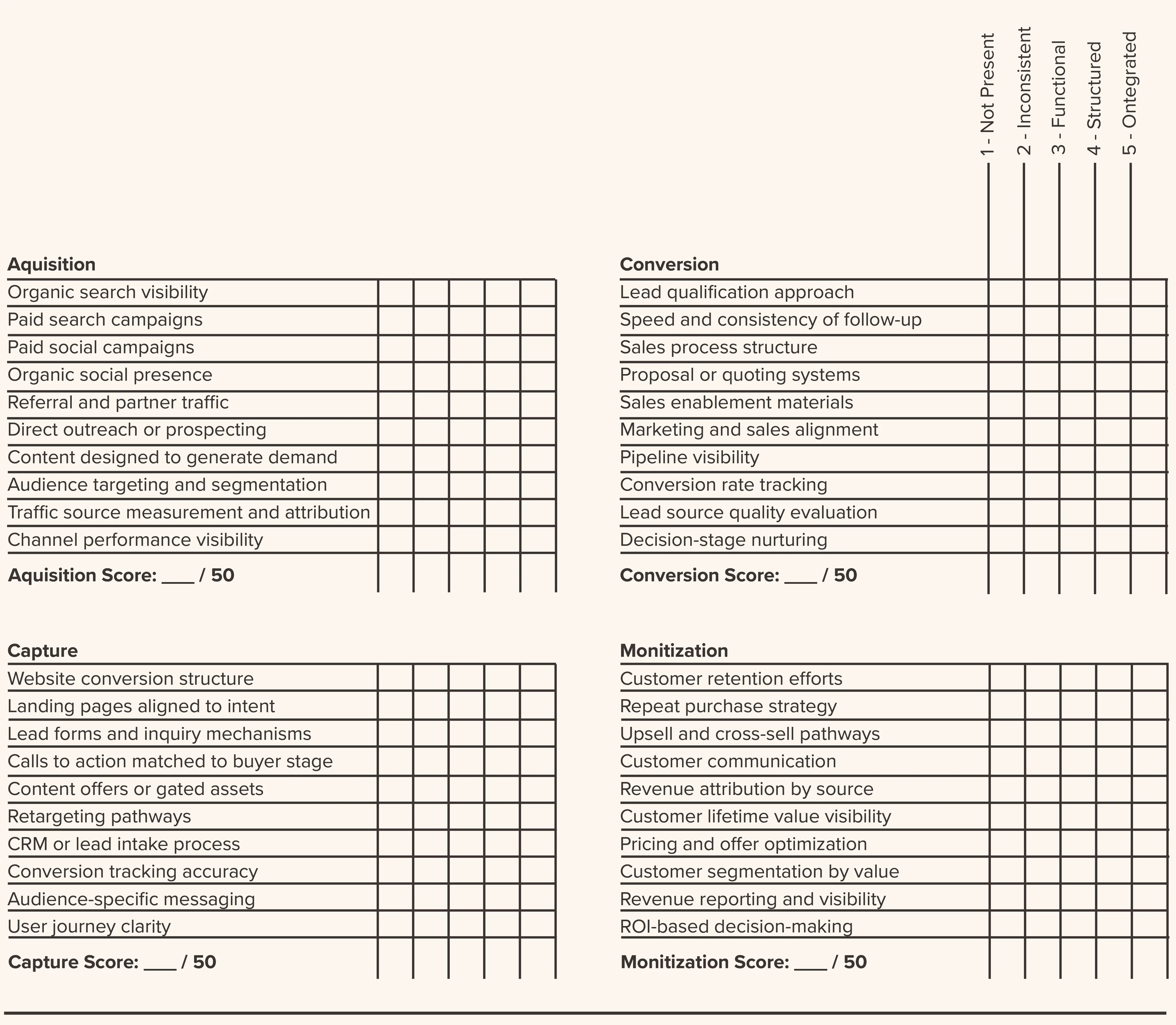
To make this more concrete, the system can be evaluated across each of its core functions. A perfect score isn’t the goal; the goal is to understand where the imbalance exists.
For example, a system with strong acquisition but weak capture will struggle to convert attention into opportunity. On the other hand, a system with effective conversion but limited monetization will generate customers without maximizing value. In each case, performance is constrained not by effort, but by the weakest point in the system.
What matters is not the total score, but where the system is uneven.

What This Means for Performance
The integrity of a marketing system determines whether results can be repeated.
When integrity is low, outcomes are inconsistent. Performance varies from period to period, and forecasting becomes unreliable. Decisions are made with limited confidence, often based on short-term indicators rather than clear patterns.
As integrity improves, variability decreases. Performance becomes more stable, more measurable, and easier to understand. Over time, this creates the conditions for predictability, which allows a business to plan, invest, and grow with confidence.
Final Perspective: From Activity to Predictability
Most businesses do not lack marketing effort. They lack a system that produces consistent results.
Without consistency, there is no predictability. Without predictability, decision-making becomes uncertain. Growth becomes reactive rather than intentional.
A structured system changes the narrative. It creates visibility into how performance is generated. It allows improvements to compound rather than reset. It transforms marketing from a series of disconnected efforts into a coordinated driver of business outcomes.
The goal is not more marketing. It is marketing that produces predictable outcomes.
Marketing System Integrity Check
Evaluate the strength, structure, and integration of the components within your marketing system.
A marketing system is not defined by the number of activities in place, but by how effectively those activities are structured, measured, and connected. Some systems lack key components entirely. Others contain the right components, but operate them inconsistently or in isolation. In both cases, performance becomes difficult to manage and nearly impossible to predict.
Use the following scale to assess each component based on its current role in your business.
Interpreting Your System
A higher score indicates stronger structure and integration across your system. A lower score typically indicates gaps in coverage, consistency, or connection between components.
The objective is not perfection. It is visibility into what is actually driving performance and what is holding it back.
Most systems are not limited by effort. They are limited by imbalance.
A missing component creates a gap.
An inconsistent component creates instability.
An unmeasured component creates uncertainty.
An integrated component creates leverage.